Book review: Women Photographers: From Julia Margaret Cameron to Cindy Sherman, Boris Friedwald
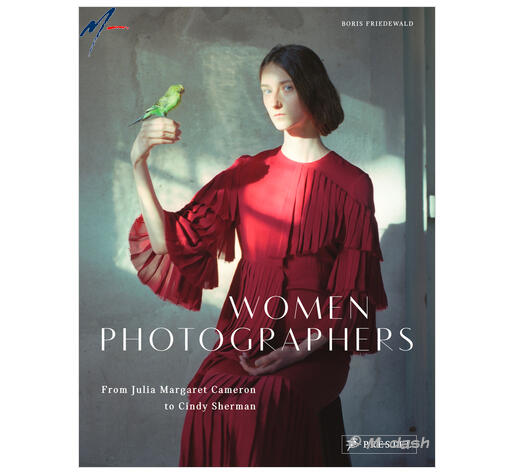
The Female in Focus award, created in 2019 by 1854 Media, publisher of the British Journal of Photography, pointed out that only 15% of photographers are women despite 80% of photography graduates being female. So, a reconsideration of Women Photographers: From Julia Margaret Cameron to Cindy Sherman, republished in 2018 seemed appropriate to get a sense of the significant contribution of women to photography.
In the introduction to this book, Boris Friedwald acknowledges that the list is incomplete. However, the basis for inclusion does seem rather uneven. The work cannot be considered comprehensive as it omits rather too many important, and well known, photographers while including some with less significant contributions.
While reading this book it soon felt incomplete as notable omissions came to mind, such as Diane Arbus, who should be in any list of major women photographers. Whatever one's views of her work, she is still highly influential, probably one the most well-known photographers, male or female, of her era. However, her estate tightly controls her image and use of her work is very restricted - the Bosworth, Lubow or Schultz biographies do not include any of her work. Most likely her estate's restrictions could make her inclusion difficult. Other obvious gaps include Mary Ellen Mark who is only mentioned as teacher of at least one photographer featured in Women Photographers. Martha Rosler is also missing despite being very influential in photography and gender studies. Where too is Annie Leibovitz?
Gerda Taro's absence too, is notable. Perhaps not well known outside photography, she had a serious, but short, photojournalistic career as she died at the frontline of the Spanish Civil War. Companion and collaborator of Robert Capa, he adopted as his name the pseudonym that he and Gerda originally used for their photojournalistic collaboration.
From the UK, as well, there are several notable omissions: Jane Bown had a six-decade career with the Observer newspaper and has an international reputation for her portraiture and her other photojournalism merits further study. Doreen Spooner, known by the patronising soubriquet of 'Camera Girl', was the first female staff photographer in London's Fleet Street and had a forty-year career that produced many well-known images. She has a strong reputation in Britain but is perhaps less well known internationally, as is Grace Robertson who had a long photojournalism career including for Picture Post and other prominent publications.
Too many omissions even without considering photographers from the rest of the world.
The book does include a narrow selection of contemporary photographers who, although well regarded today, are not guaranteed to stand the test of time. That is always a risk and it would perhaps have been better to create the work as two volumes: a standard definitive catalogue of photographers with proven historical significance, including those suggested above and others. A second book of recent and current photographers to watch, now and in the future—revised editions could then reflect changing reputations and the emergence of new stars.
The single page biographies are necessarily short but give a sense of the photographer and her work. The format of 1-3 images hardly does justice to many photographers' lifetimes work. Often the images are not their best known. That is useful in that it adds new images for those of us familiar with the photographer's well-known work. It does risk downplaying the significance of the photographer for those who do not know them but might recognise their better-known work.
A thread that runs through many of the biographies is that many of these women did not start out as photographers. They came to it from many different directions, often finding photography quite late in life, finding in photography a tool for exploring and communicating their other enthusiasms and interests. Photography then was not end in itself, as it is for many amateurs and aspiring-professional photographers. Instead, it shows instead that success in photography, as in the arts more widely, comes from a concern, a passion and having something to say or to explore.
This book, written by a white man, highlights an underlying problem across all aspects of society, not just in photography. Too often there are photographers (without a qualifying adjective), usually implying white, middle-class, college educated, males, and then there are women, black, queer, Jewish, Muslim photographers—the qualification perpetuating the idea of difference. So, despite showcasing women who have been traditionally marginalised, it can be argued that this book perpetuates the issue.
Overall, Women Photographers forms a useful but fundamentally incomplete catalogue of women photographers. However, it does show how influential women have been throughout photography's 180-year history. This book contributes to the view that women have had disproportionate influence despite the domination of the field for much of its history by men (and it is still a very male field). Women Photographers also provides insights into the important, and often under-appreciated, role of women in photography's development, despite only one in seven photographers being female. Hopefully this book will lead readers to explore, in more depth, women photographers’ contribution to and through photography.
Women Photographers: From Julia Margaret Cameron to Cindy Sherman by Boris Friedwald (ISBN: 978-3-7913-8466-5) is a high-quality large format paperback republished in 2018 (originally published 2014) by Prestel Publishing in the UK priced at £17.99.
Add new comment